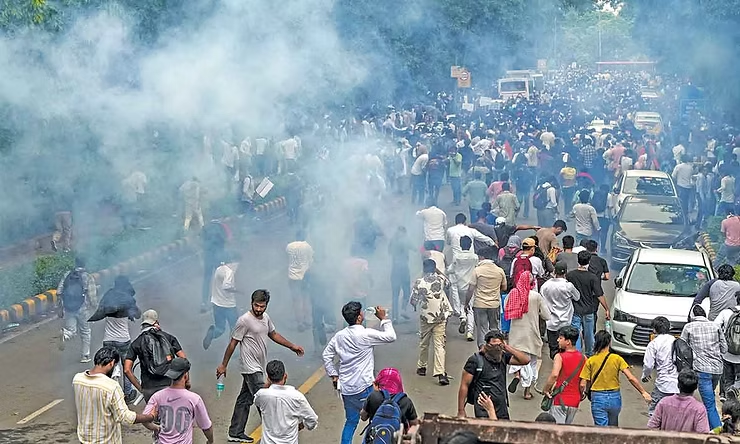
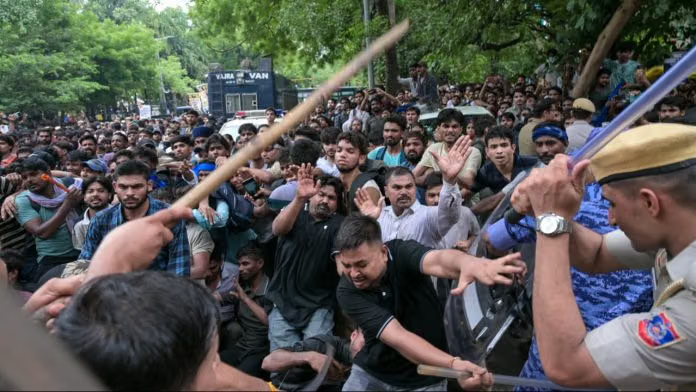
The events that unfolded at Jantar Mantar on 20 July have become a defining moment in India’s growing youth-led protests. Thousands of young people from across the country gathered to voice their frustration over repeated competitive examination paper leaks, unemployment, and what they perceive as the government’s inability to effectively address these issues.
Despite heavy barricading and the deployment of Delhi Police and Rapid Action Force (RAF) personnel, protesters marched towards Parliament, highlighting the increasing momentum behind the movement. The demonstrations have sparked a nationwide debate about education reforms, transparency in recruitment examinations, and accountability in governance.
Questions Raised Over CJP’s Role in the Movement
Questions surrounding the Cockroach Janta Party (CJP) emerged shortly after the organization appeared in late May. Critics questioned the motives of its leadership due to their sudden emergence and reported political associations with members previously linked to the Aam Aadmi Party (AAP).
Some political observers alleged that the movement was intended to divert public attention from the growing opposition campaign against examination paper leaks. These concerns gained further attention after Sonam Wangchuk claimed that he was asked by the Lieutenant Governor of Ladakh to contact Abhijeet Dipke, the founder of CJP.
CJP’s primary demand—the resignation of Union Education Minister Dharmendra Pradhan—was also viewed by some as an attempt to limit the broader conversation surrounding educational reforms, paper leaks, and unemployment. Meanwhile, opposition leaders have continued organizing rallies that attracted significant participation from students and young job aspirants across India.
Rahul Gandhi, Leader of the Opposition in the Lok Sabha, has held multiple public meetings focusing on paper leaks, declining educational standards, and employment-related challenges. These gatherings reportedly witnessed substantial youth participation and widespread public engagement.
Youth Protest Expands Beyond Its Original Leadership
Initially, CJP’s campaign received a limited public response. However, Sonam Wangchuk’s prolonged hunger strike and the subsequent call for a march to Parliament significantly expanded public participation. Young people from various states joined the demonstrations, transforming them into a larger platform for expressing dissatisfaction over governance issues affecting India’s youth.
The scope of the protests widened considerably, encompassing concerns about examination integrity, unemployment, rising living costs, and perceived administrative failures. The movement increasingly became representative of broader public frustrations rather than a single political demand.
Out of CJP’s Control
The developments at Jantar Mantar and the subsequent police action against protesters suggest that the movement has evolved beyond the control of its original organizers. What may have begun as a limited campaign has now grown into a nationwide expression of youth concerns.
Political analysts argue that public support for the protests has become increasingly organic, attracting individuals across age groups and social backgrounds. Notably, several observers pointed out that key CJP leaders were not visibly present during the march towards Parliament.
Regardless of political affiliations, the protests have underscored a significant issue confronting India’s education and recruitment systems—the repeated leakage of examination papers.
The Growing Crisis of Examination Paper Leaks in India
An isolated instance of a paper leak might reasonably be attributed to administrative failure. However, repeated occurrences across multiple examinations have intensified public concerns regarding institutional accountability and systemic weaknesses.
Competitive examinations represent years of hard work, financial sacrifice, and emotional investment for millions of students. When examination papers are leaked, deserving candidates are deprived of fair opportunities, while those willing and able to pay illicitly gain an unfair advantage.
Such practices not only undermine meritocracy but also weaken public confidence in the country’s educational and recruitment mechanisms. The consequences extend beyond delayed examinations and cancelled results—they affect careers, financial stability, and mental well-being.
Public discourse surrounding the NEET paper leak controversy further highlighted these concerns, bringing national attention to the immense psychological pressure faced by students preparing for competitive examinations.
Jantar Mantar Crackdown Reflects Wider Public Discontent
The handling of the protests at Jantar Mantar has become a focal point of criticism. Images and reports emerging from the demonstrations have contributed to a broader conversation about democratic dissent, public accountability, and the government’s response to citizen movements.
Public dissatisfaction appears to extend beyond examination-related issues. Concerns regarding unemployment, stagnant wages, inflation, and administrative responsiveness continue to resonate among India’s youth and middle-class population.
Many protesters view these demonstrations as symbolic of larger governance challenges affecting their everyday lives.
India’s Youth Demand Meaningful Change
India possesses one of the world’s youngest populations. Today’s generation is highly informed, digitally connected, and increasingly aspirational. Young Indians expect transparency, merit-based opportunities, and responsive governance.
Recent developments in neighboring countries such as Nepal and Bangladesh have demonstrated how youth-led movements can significantly influence political discourse. While India’s democratic and social landscape is distinct, these examples underscore the importance of addressing legitimate public concerns through meaningful reforms.
For India, the path forward requires urgent attention to key challenges, including:
- Examination paper leaks and recruitment transparency.
- Rising unemployment among young people.
- Stagnant wages and increasing living costs.
- Administrative accountability and institutional reforms.
- Equal opportunities and social inclusion.
- Strengthening public trust in educational and recruitment systems
The events at Jantar Mantar have made one reality clear: India’s youth are demanding more than promises. They are seeking accountability, fairness, and meaningful opportunities for their future.
Failure to address these concerns promptly risks deepening public dissatisfaction and prolonging social unrest. Meaningful engagement and effective policy responses will ultimately determine whether these protests become a turning point for reform or another missed opportunity.